FlashPhraseFlashPhrase
← Back to top

FlashPhrase Blog

Politely Interrupting Someone Who Talks Too Long

March 3, 2026

We've all been there: a meeting is underway, and one person, perhaps with the best intentions, continues to elaborate on a point, stretching minutes into what feels like an eternity. While their contributions might be valuable, these extended monologues can quickly derail the agenda, eating into precious time and preventing others from sharing their insights.

Addressing this situation directly can feel awkward, especially in a professional setting. Phrases like "That's enough" or "We're running out of time" can come across as abrupt, rude, or even dismissive. In business English, a more nuanced approach is often preferred, one that prioritizes maintaining a respectful atmosphere while still managing the meeting effectively.

The key is to shift from directly "stopping" someone to gently "pausing" them. This subtle difference in phrasing shows respect for the speaker and the ongoing discussion. It signals that your intervention isn't a rejection of their ideas but a necessary step for broader time management.

This is where a phrase like "Can I pause you there for a second?" becomes incredibly useful. It's a perfectly crafted tool for gracefully regaining control of the conversation without causing offense. It allows you to interject smoothly and redirect the discussion.

Using "Can I pause you there for a second?" works wonders because it does several important things simultaneously. Firstly, it avoids invalidating the speaker's contribution; you're not telling them they are wrong or their points are irrelevant. Secondly, it signals that you respect the flow of the discussion, implying you want to integrate their points effectively rather than shut them down.

Crucially, this phrase clearly communicates that your intervention is for time management, not personal disagreement. You're acknowledging their input but gently steering the conversation back on track or opening the floor to others. It's an efficient way to manage a talkative colleague without creating tension.

Imagine a scenario: A colleague is explaining a technical detail for the fifth minute. You could say, "Can I pause you there for a second? I want to make sure we leave enough time for John to present his updates before we wrap up." This immediately clarifies your intention and redirects the focus.

A vital point in business English learning is to acquire expressions that help you control the "flow" of a conversation, rather than attempting to control the "person" speaking. "Can I pause you there for a second?" embodies this principle perfectly. It's not about silencing someone, but about ensuring equitable participation and efficient progress.

What makes this phrase even more powerful is its practicality. You don't need to be the designated facilitator to use it. Anyone can employ this simple, effective line to ensure meetings stay productive and everyone has a chance to contribute. Mastering such polite interventions is a significant step towards smoother, more collaborative business communications.

Takeaway phrases

  • Can I pause you there for a second?

Making a Strong Point Without Sounding Aggressive

March 2, 2026

In many business meetings, there comes a moment when you need to articulate your stance clearly and unequivocally. It's essential to ensure your perspective is heard and understood, especially when important decisions are on the line.

However, there's a subtle but significant difference between emphasizing a point and sounding overly forceful or aggressive. Pushing too hard can sometimes shut down productive dialogue rather than foster agreement.

In English-speaking business environments, particularly in meetings, there's a strong preference for well-organized presentation over sheer argumentative strength. The goal is to convey your message logically, making it easy for others to follow and accept.

This is where phrases designed for clarity and re-framing become invaluable. One such powerful phrase is "What I’m trying to say is…"

Using "What I’m trying to say is…" signals that you are not being emotional but rather attempting to clarify and organize your thoughts. It gives the impression that you are refining your argument, helping listeners grasp the core point without any perceived hostility.

This phrase allows you to articulate your "intended meaning" more precisely, ensuring your audience fully comprehends your perspective. It re-directs the conversation back to your central argument in a constructive way.

It’s not about merely repeating your assertion louder or more often; instead, it encourages you to rephrase or restructure your argument for better understanding. This approach is much more constructive and persuasive than simply reiterating the same point.

A key takeaway for business English learners is to cultivate expressions that persuade through clarity and precision, rather than through blunt force. Nuance is often more effective than direct confrontation.

Ultimately, the ability to state your position clearly and firmly, while simultaneously avoiding language that might incite conflict, is a crucial skill. Phrases like "What I’m trying to say is…" are excellent tools for achieving this balance.

Takeaway phrases

  • What I’m trying to say is…

Why You Forget English During Meetings

February 27, 2026

It is not your level. It is mental overload.

You prepared.
You reviewed useful phrases.
You even felt confident before the meeting began.

Then someone asks you a direct question, and suddenly your mind goes blank.

Many professionals interpret this moment as proof that their English is not good enough.
In reality, it is rarely about language ability.
It is about mental overload.

During a meeting, your brain is managing multiple tasks at the same time.
You are listening carefully.
You are processing business information.
You are planning your response.
You are reading the reactions of others.
You are thinking about time, hierarchy, and expectations.

That is a heavy cognitive load, even in your native language.
In a second language, the load becomes significantly higher.

Under pressure, the brain does not prioritize elegant expression.
It prioritizes speed and survival.
When stress increases, working memory shrinks.
And when working memory shrinks, word recall becomes unstable.

That is why you knew the phrase yesterday but cannot access it today.
The knowledge is there.
The retrieval pathway is blocked by overload.

There is also a psychological layer.
Meetings often involve evaluation.
You may be speaking in front of managers, clients, or international colleagues.
The fear of making mistakes increases self-monitoring, which adds even more mental strain.

The answer is not studying more grammar.
It is reducing cognitive demand before the meeting begins.

When you prepare a small number of key sentences in advance, you remove part of the mental burden.
When those sentences are familiar, they require less effort to retrieve.
Familiar language survives pressure.

This is why simple, repeatable expressions often outperform complex ones in real discussions.
Clarity reduces load.
Preparation reduces anxiety.
Repetition builds automaticity.

Business English improves not when you add more input, but when you remove friction.

FlashPhrase supports this kind of preparation cycle.
By turning your own meeting context into practice material, it helps you rehearse language that is immediately relevant.
Instead of trying to remember everything, you focus on what you are most likely to say.

Forgetting English in meetings is not a failure.
It is a sign that your brain is overloaded.
Lower the load, and your English will show up when you need it.


Buying Time Before Giving Bad News in a Meeting

February 25, 2026

We've all been there: a meeting where you need to deliver less-than-positive news. Perhaps it's a project delay, an unexpected issue, or a target that won't be met. These are tough moments for any professional.

In such situations, how you communicate the problem can often be more important than the problem itself. Simply stating the issue directly can sometimes come across as defensive, or even like you're making excuses.

Especially in English-speaking business environments, establishing an upfront attitude of honesty and openness is crucial for maintaining trust. Your audience will appreciate your sincerity even before they hear the details of the problem.

This is where a powerful introductory phrase can save the day and build confidence. One of the most effective ways to signal your integrity and preparedness is by saying, "I want to be transparent about something."

When you use "I want to be transparent about something," you immediately signal a few key things. First, you are indicating that you are not hiding any information. Second, you are taking responsibility and showing that you are prepared to share the full picture.

For instance, you might begin by saying, "Good morning, everyone. I want to be transparent about something regarding the Q3 product launch timeline. We've encountered an unforeseen challenge with supplier logistics, which will impact our original schedule." This prepares your audience for the news in a constructive way.

The core lesson here for business English learners is to understand the power of a prefacing remark, especially when the content is negative. It's not about softening the blow; it's about establishing trust and showing professional accountability.

By starting with such a clear statement of intent, you transform the act of sharing a problem from a perceived risk into an opportunity for building stronger trust with your team and stakeholders. This small phrase makes a big difference.

Takeaway phrases

  • I want to be transparent about something.

Softening Direct Requests in English Meetings

February 23, 2026

In the professional world, clear communication is essential, but sometimes directness can be perceived as too blunt or demanding, especially when making requests.

This is particularly true in international business environments where cultural norms around politeness can vary significantly. Learning to soften your requests can greatly improve your working relationships and the likelihood of getting a positive response.

One exceptionally useful phrase for this is "Would you mind taking a look at this?" It’s a polite and indirect way to ask for assistance without sounding overly demanding.

The initial part, "Would you mind," is a powerful softener. It frames your request as a question about the other person's willingness or convenience, rather than a direct instruction. This shows respect for their time and autonomy.

Following with "taking a look" makes the request feel less imposing. It implies a quick, informal review or glance, rather than a deep, time-consuming analysis or a formal "review this document." This reduces the perceived burden on the other person.

For instance, if you've prepared a presentation slide and want a colleague's quick feedback before a meeting, you might say, "Hey, I just finished this slide. Would you mind taking a look at this before we start?" This is far more courteous than "Check this slide."

This phrase is ideal when you need someone to review a document, presentation, email, or a piece of work where a quick, informed opinion or check is sufficient. It allows the other person to feel less obligated and more willing to help.

Mastering phrases like "Would you mind taking a look at this?" significantly enhances your professional communication. It demonstrates consideration for your colleagues' time and workload, fostering stronger professional relationships and a more collaborative atmosphere.

Takeaway phrases

  • Would you mind taking a look at this?

Buying Yourself Time When You’re Asked an Unexpected Question

February 21, 2026

Imagine you're in an important business meeting. Suddenly, a question comes your way that you hadn't anticipated. It's complex, perhaps requires data you don't have at your fingertips, or just needs a moment of thought.

In such moments, a common reaction is either silence or a rush to provide an incomplete answer. This can create an impression of being unprepared or flustered, which isn't ideal in a professional setting.

Especially in English-speaking business environments, it’s crucial to show a "reaction" rather than going silent. Even if you don't have an immediate answer, acknowledging the question signals engagement and professionalism.

This is where a simple yet powerful phrase comes in handy: "That’s an interesting question." It’s a polite and effective way to buy yourself valuable thinking time without appearing evasive.

By saying "That’s an interesting question," you immediately fill the silence and gain a few precious seconds. These moments allow your brain to process the information, recall details, or formulate a more coherent response.

More than just buying time, this phrase helps you avoid sounding defensive. Instead of hesitating or making excuses, you're framing the question in a positive light, even if it's challenging.

It projects a positive and thoughtful attitude. You're signaling that you're taking the question seriously and are prepared to engage with it, rather than being caught off guard.

In business communication, sometimes the "posture" or attitude you project before delivering content is as important as the content itself. This approach builds trust by showing you are composed and respectful.

So, the next time you're put on the spot, try responding with, "That’s an interesting question. Let me just think about that for a moment." Then, take a breath and gather your thoughts.

For business English learners, the key isn't always about having the ability to answer every question instantly. More often, it's about mastering those brief "pause phrases" that allow you to manage the conversation and respond thoughtfully.

Takeaway phrases

  • That’s an interesting question.

The Most Useful Business English Phrases for Meetings

February 17, 2026

Simple expressions that work in real conversations

Many learners believe that effective business English requires advanced vocabulary.

In reality, the most useful phrases in meetings are often short and simple.

They are used repeatedly in global companies, regardless of industry.

The first group of useful phrases helps you clarify ideas.

Meetings move quickly, and misunderstandings are common.

Expressions such as “Let me clarify my point,” “Just to be clear,” and “What I mean is…” allow you to slow the conversation slightly and ensure your message is understood.

These phrases are powerful because they help control the flow of discussion.

The second group helps you confirm alignment.

Business meetings are not only about sharing information.

They are about making sure everyone agrees on the next step.

Phrases like “Just to confirm,” “Are we aligned on this?” and “So the next step is…” create structure and reduce confusion.

They are especially important in international teams where assumptions can differ.

The third group is useful when you need time to think.

Unexpected questions are common, and silence can feel uncomfortable.

Instead of rushing into unclear answers, you can say “That’s a good question,” “Let me think about that for a moment,” or “Let me get back to you on that.”

These expressions give you space without losing professionalism.

Another essential category involves expressing opinions carefully.

Direct disagreement can sometimes sound too strong in multicultural settings.

Phrases such as “From our perspective,” “One concern we have is…” or “We may need to reconsider…” help soften your message while still being clear.

What makes these phrases effective is not complexity.

It is reliability.

They are flexible and can be adapted to many different situations.

Even learners preparing for exams like TOEIC or IELTS will find that these expressions appear frequently in speaking tasks.

The key is not memorizing long lists.

Choose a small number of phrases that match your role and repeat them until they feel natural.

Over time, they become automatic tools you can rely on under pressure.

FlashPhrase helps professionals identify and practice exactly these kinds of expressions using their own meeting context.

By focusing on the phrases that appear in real work situations, learners can build confidence faster and prepare more effectively.

In business meetings, clarity is more valuable than complexity.

The most useful English phrases are often the simplest ones you can use consistently.

Admitting You Don’t Know Something Professionally

February 16, 2026

Imagine you're in an important business meeting. A colleague asks a specific question about a project, and suddenly, you realize you don't have the exact data or the immediate insight to provide a full answer. This situation is more common than you might think, and how you respond makes all the difference.

The challenge isn't that you don't have the answer; it's how you communicate that fact. Trying to invent an answer on the spot or providing vague information can damage your credibility and create more problems down the line. In professional settings, honesty and clarity are always valued.

Instead of fumbling for words or giving a hesitant guess, a strong, professional response is to simply state your current position. A highly effective phrase for this is: "I don’t have the answer to that right now." This clear statement is direct and immediately communicates your situation.

Using "I don’t have the answer to that right now" shows integrity and a responsible attitude. It tells your colleagues that you value accuracy over a quick, potentially incorrect response. This approach builds trust, as others know you will provide reliable information when you have it, rather than guessing.

In English-speaking business environments, the ability to calmly and clearly address uncertainty is often valued more than simply knowing every single detail. It demonstrates strong communication skills and a professional demeanor. This phrase allows you to manage expectations effectively without losing face.

You can use this phrase when a question goes beyond your immediate knowledge, requires checking data, or needs input from another team member. It's suitable for situations where providing an instant, accurate response is genuinely not possible. It's about being factual and confident in your limitation at that moment.

To further reinforce your responsible stance, you can add a commitment to find the information. For example, you could say, "I don’t have the answer to that right now, but I will look into it immediately and get back to you by end of day." This turns a temporary lack of knowledge into a plan of action.

Mastering phrases like "I don’t have the answer to that right now" is a key part of practical business English. It teaches you to handle uncertainty with poise and professionalism. By being direct and transparent, you maintain credibility and show strong leadership, even when facing the unknown.

Takeaway phrases

  • I don’t have the answer to that right now.

How to Prepare Your English Before Meetings

February 14, 2026

Simple habits that make a real difference

Many professionals believe that speaking better English in meetings requires years of study.
In reality, small preparation habits before each meeting can dramatically improve performance.

Meeting English is rarely spontaneous.
The people who sound confident are often the ones who prepared specific phrases in advance.

The first step is to predict what you will need to say.
Before a meeting, ask yourself three simple questions.
What update will I give?
What questions might I receive?
What opinion do I need to express?

Most meetings follow patterns.
You may need to explain progress, clarify a delay, suggest an idea, or respond to feedback.
If you prepare one or two sentences for each likely situation, you reduce the pressure during the actual discussion.

The second step is to simplify your message.
Many learners try to create complex sentences.
This increases anxiety and makes mistakes more likely.
Instead, break your message into short, clear statements.
Clarity builds confidence.

The third step is to rehearse out loud.
Silent preparation is not enough.
Speaking your sentences once or twice before the meeting helps your brain access them faster.
Even a brief rehearsal makes a difference when you are under pressure.

Another powerful habit is reviewing previous meetings.
After a meeting ends, reflect on what you wanted to say but could not express clearly.
Rewrite those ideas in simple English.
Over time, you will build a reliable set of expressions that match your actual role and responsibilities.

This approach is very different from traditional test preparation for exams such as TOEIC or IELTS.
Test training focuses on broad ability.
Meeting preparation focuses on immediate usefulness.

The closer your practice is to your real work, the faster your confidence grows.

FlashPhrase supports this preparation cycle.
By turning your meeting notes into practical training material, it helps you prepare what to say before your next discussion and reflect on what you said afterward.
Instead of studying abstract content, you prepare for real conversations that matter to you.

Strong meeting performance does not begin when the meeting starts.
It begins with preparation.

Politely Ending a Conversation That's Going Nowhere

February 13, 2026

Have you ever been in a business meeting where a discussion point spirals out of control? A specific topic captures the attention of a few individuals, while the rest of the team quietly checks their watches. It's a common scenario where valuable meeting time is consumed by a deep dive that's only relevant to a small fraction of attendees.

This often happens when a detailed issue that should be explored by a small, focused group ends up consuming precious minutes in a larger, general meeting. It can halt progress on the main agenda and frustrate other participants who need to move on.

In English business meetings, the ability to gracefully end or redirect such a prolonged discussion is a vital skill. Simply saying, “Let’s stop talking about this,” can sound abrupt or even rude, which is not ideal in a professional setting.

Instead of directly halting the conversation, a more effective approach is to propose a different way to handle the topic. This shifts the focus from stopping the discussion to finding a more appropriate context for it.

This is where the phrase "Maybe this is something we can take offline" becomes incredibly useful. It's a professional and polite way to suggest moving a discussion out of the current group setting.

The nuance of "take it offline" is crucial. It’s not a denial or a rejection of the topic's importance. Instead, it's a suggestion to "move the discussion to a different venue" – meaning a separate, smaller meeting, an email thread, or a private conversation.

This phrase implies that the topic is worthy of further attention, but in a more focused environment. It helps to preserve the main meeting’s agenda and time, ensuring efficiency for everyone involved.

You should use it when a conversation becomes too detailed for the entire group, when it's veering off-topic, or when time is running short. It allows you to address the issue respectfully while maintaining the flow of the primary meeting.

For example, you could say: "That's an important point, and I appreciate you raising it, but given our agenda, Maybe this is something we can take offline with just the relevant stakeholders."

A key learning point in business English is to have expressions that don't just stop a discussion, but skillfully relocate or redirect it. This demonstrates strong leadership and communication skills.

Mastering phrases like "Maybe this is something we can take offline" will help you manage meetings more effectively, keep discussions productive, and ensure everyone's time is respected.

Takeaway phrases

  • Maybe this is something we can take offline.

Giving Positive Feedback Without Sounding Generic

February 12, 2026

In English meetings, providing effective feedback is crucial for moving discussions forward. It shows you're engaged, listening, and contributing to the collective intelligence of the team.

However, many business English learners find themselves relying on simple expressions like "Good idea" or "Sounds good." While these aren't inherently wrong, they often lack specificity and impact, making your feedback sound generic and less meaningful.

In professional settings, particularly in English-speaking environments, feedback that focuses on the "quality" or "perspective" of the content is highly valued. It goes beyond mere agreement to acknowledge deeper insights.

By giving specific feedback, you strengthen the speaker's contribution and can even broaden the discussion by highlighting nuances. This shows a deeper level of engagement and critical thinking.

For non-native speakers, having a ready-to-use, natural phrase that conveys genuine appreciation for a well-thought-out idea is incredibly helpful. You don't need complex compliments; you need impactful simplicity.

This is where a phrase like "That’s a really thoughtful point" comes in handy. It's a powerful yet simple way to acknowledge someone's valuable input without sounding vague.

What does "That’s a really thoughtful point" mean? It signifies that the speaker has presented an idea or observation that shows deep consideration, insight, or a unique perspective. You're acknowledging their intellectual effort.

You should use "That’s a really thoughtful point" when someone shares an idea that isn't just "good," but demonstrates careful analysis, considers multiple angles, or uncovers a nuance others might have missed. It elevates the discussion.

For example, if a colleague suggests a new approach to a marketing campaign, saying "That’s a really thoughtful point, considering our budget constraints and target demographic," shows you've grasped the depth of their suggestion. It adds significant value to the exchange.

The key for business English learning is to move beyond abstract agreement. It's about acquiring expressions that help you articulate value and genuinely engage with complex ideas.

Using phrases like "That’s a really thoughtful point" allows you to do just that. It enables you to give positive feedback effectively, reinforce good ideas, and contribute more meaningfully to any discussion.

Takeaway phrases

  • That’s a really thoughtful point.

Three Mistakes That Prevent People from Improving Their Business English

February 10, 2026

And why hard work alone is not enough


Many professionals study business English seriously.
They buy books, use apps, and prepare for exams like TOEIC or IELTS.
Yet despite this effort, their English does not improve in real meetings or discussions.

The reason is often not a lack of motivation or ability.
Instead, many learners share a few common misunderstandings about how business English actually works.


The first mistake is believing that more vocabulary automatically leads to better communication.
Many learners focus on memorizing new words every day, expecting this to make them more fluent.
In reality, business conversations rely heavily on a limited set of common expressions.
What matters most is knowing how to use familiar words clearly and confidently, not how many advanced terms you recognize.


The second mistake is assuming that test scores reflect real business performance.
High scores in TOEIC or IELTS show strong reading and listening skills, but meetings require different abilities.
In real work situations, you need to respond quickly, explain your thinking, and adjust your message based on the listener.
These skills are rarely trained directly through test preparation alone.


The third mistake is aiming to sound like a native speaker from the beginning.
Many learners hesitate to speak because they want their English to be perfect.
As a result, they stay silent in meetings or keep their comments extremely short.
In business settings, clarity and timing are far more important than accent or perfect grammar.
Speaking simply but clearly is often the most effective approach.

What these three mistakes have in common is a focus on abstract learning rather than real usage.

Business English improves fastest when practice is closely connected to actual work situations.
Preparing what you will say, using it in real meetings, and reflecting afterward creates steady progress.

This is why a new type of learning support is becoming important.
Instead of studying generic examples, learners benefit from working with language taken directly from their own work.


FlashPhrase was designed around this idea.
By turning real meeting notes into practical English practice, it helps learners focus on the expressions they actually need at work.
Rather than chasing perfection, users build confidence through preparation and repetition in real contexts.


Improving business English is not about studying harder.
It is about avoiding these common misunderstandings and learning in a way that matches how English is truly used in business.

Acknowledging Tension Without Making It Worse

February 10, 2026

In business meetings, it's common for unspoken feelings to create an atmosphere of unease. When tension is present but left unaddressed, it can silently stall discussions and prevent progress, even though tension itself isn't abnormal.

This unacknowledged atmosphere often leads to unproductive silence or circular arguments. Important decisions get postponed, and teams struggle to move forward because the underlying emotional current is ignored rather than managed.

A powerful strategy in English-speaking business environments is to acknowledge the "state that exists" rather than directly evaluating specific emotions. This approach is objective and less confrontational, focusing on the observable atmosphere.

This is where a phrase like "I feel there’s a bit of tension around this" becomes incredibly useful. It's a gentle yet direct way to bring an unspoken truth into the open, creating an opportunity for everyone to acknowledge it.

Notice the wording: "I feel" makes it a personal observation, not an accusation. "A bit of tension" minimizes the perceived drama while still naming the elephant in the room. It’s an observation, not a judgment.

By simply verbalizing "I feel there’s a bit of tension around this," you create an immediate cooling effect. You're sharing the "temperature" of the room, allowing others to acknowledge it before anyone gets blamed or before the validity of the discussion itself is questioned.

This attitude of neither denying the tension nor overplaying it, but simply stating it as a fact, is crucial for constructive dialogue. It allows the team to pause, reflect, and then re-engage with a shared understanding of the atmosphere.

For business English learners, mastering such phrases is key. The goal is to verbalize the atmosphere without inflaming emotions, providing a neutral observation that helps reset the group dynamic.

A short, well-placed phrase like "I feel there’s a bit of tension around this" can profoundly impact a meeting. It helps to regulate the mood, making it easier for the team to achieve consensus or smoothly transition to a different topic.

By bravely, yet calmly, acknowledging the elephant in the room, you demonstrate leadership and help guide discussions back to productivity. Practice using these phrases to become a more effective communicator in any business setting.

Takeaway phrases

  • I feel there’s a bit of tension around this.

Resetting a Stuck Discussion in English Meetings

February 7, 2026

We've all been there: a meeting starts with great energy, but somewhere along the line, the discussion grinds to a halt. It's a common and often frustrating challenge in business communication, especially in English meetings. You might even feel the energy in the room start to dip.

Regularly, we encounter moments where a discussion just won't move forward. This often manifests as repeating the same points or a prolonged conflict of opinions, which drains the energy of the entire meeting and leaves everyone feeling unproductive.

The core issue in these situations is often not the content itself, but rather that the 'flow' of the conversation has stagnated. It feels like everyone is talking, but no real progress is being made towards a decision or a clear next step.

In English meetings, you have a powerful tool at your disposal to counteract this: the ability to objectively verbalize the situation. By putting words to the current state of the discussion, you can effectively reset the atmosphere and bring new life into the room.

This is where a phrase like “Maybe we’re getting a bit stuck here” becomes incredibly valuable. It's a neutral observation, not a criticism. It gently points out the shared reality that the discussion isn't progressing as intended.

Rather than negating someone's opinion or trying to push a specific agenda, sharing the state of the discussion is much more readily accepted. It frames the issue as a collective challenge, inviting collaboration rather than defensiveness from any individual.

The phrase “Maybe we’re getting a bit stuck here” signals a pause. It’s an invitation for everyone to acknowledge the current impasse and collectively decide on the next steps. For example, you might say, “Maybe we’re getting a bit stuck here. Should we try approaching this from a different angle?”

A crucial point for business English learners is to develop a repertoire of phrases that describe the state of a discussion, rather than evaluating its content or others' contributions. This approach keeps the conversation constructive and professional.

A short, well-placed statement like this can dramatically change the flow of a meeting. It creates a natural opening to suggest a different perspective, propose a break, or move on to the next agenda item, allowing the discussion to regain momentum.

Mastering such expressions empowers you to be a more effective communicator and contributor in any English business setting. You're not just speaking English; you're actively managing the dynamics of the conversation, ensuring productivity and positive outcomes.

Takeaway phrases

  • Maybe we’re getting a bit stuck here.

Lightening the Mood in English Meetings

February 6, 2026

In global English meetings, the quality of discussion isn't just about the facts presented. The overall atmosphere and emotional temperature in the room can significantly impact how productive and constructive your conversations are.

Imagine a meeting where opinions clash continuously, or the discussion gets stuck in a loop. As tension builds, participants often become less open to new ideas, and constructive thinking can become difficult for everyone involved.

In such situations, pushing harder with more data or logic might not be the most effective approach. Sometimes, a single, well-placed phrase that helps reset the atmosphere can be far more powerful.

There's a cultural tendency in English-speaking business environments to use light humor or objective observations to ease tension. This helps steer discussions back towards a positive and collaborative direction.

For non-native speakers, finding the right words to lighten the mood can feel challenging, almost like trying to crack a complex joke. However, you don't need elaborate expressions or perfect humor. The real key is simply to verbalize the current mood and acknowledge that everyone is sharing the same moment.

This brings us to a highly effective and simple phrase for these very situations: "Let’s take a step back for a moment."

When you say "Let’s take a step back for a moment," you are essentially suggesting a brief pause. It implies that the current approach might not be working, and it invites everyone to gain some perspective, without blaming anyone or demanding a solution immediately.

Use this phrase when debates are getting heated, when the conversation feels stuck in an unproductive cycle, or when you sense rising frustration. It's an invitation to collectively hit the reset button and re-evaluate the discussion from a slightly different angle.

For example, if two colleagues are debating fiercely over a minor detail, you might interject with: "We seem to be getting a bit bogged down here. "Let’s take a step back for a moment" and look at the bigger picture."

This simple phrase works because it acknowledges the shared experience and offers a gentle redirect. It shows leadership and emotional intelligence, allowing the group to collectively shift focus without losing face.

Mastering these simple yet impactful phrases is a crucial contribution in global meetings. It proves that you can do more than just present your arguments; you can also skilfully manage the flow and atmosphere of the entire discussion.

Takeaway phrases

  • Let’s take a step back for a moment.

How Global Business Leaders Trained Their Business English

February 6, 2026

What real stories tell us about effective learning

Many people believe that successful global leaders speak perfect English from the beginning. In reality, many of them learned business English gradually, through real work rather than formal study. Their experiences offer useful hints for today’s learners.

Satya Nadella, CEO of Microsoft, grew up and was educated in India before moving to the United States. In interviews, he has often emphasized the importance of listening carefully and expressing ideas clearly rather than focusing on perfect language. His communication style is calm and simple, especially in meetings with diverse global teams. This reflects a key lesson: effective business English is about clarity and empathy, not complex vocabulary.


Indra Nooyi, former CEO of PepsiCo, is another example of a global leader who built her career in a second language. She has spoken about the need to adapt communication styles to different audiences, from board members to frontline employees. Her approach highlights how business English is deeply connected to leadership, persuasion, and context, not just language accuracy.


Sundar Pichai, CEO of Google, also developed his business English through education and work outside his home country. Known for his clear and structured way of speaking, he often explains complex ideas using simple language. This ability comes not from memorizing phrases, but from repeatedly explaining real work topics in English over many years.

These examples share an important pattern.None of these leaders learned business English only from textbooks or test preparation.Their English improved because they used it daily to explain ideas, solve problems, and make decisions.Work itself became their training ground.


For many professionals today, this kind of learning still feels difficult. Real meetings are fast, and there is little time to reflect or practice afterward. Even experienced learners often think, “I should have said that differently,” but move on without revisiting it. This is exactly where a new type of service becomes valuable. Instead of separating learning from work, it connects them.


FlashPhrase helps learners train their business English using their own meeting notes and real workplace context. By turning everyday communication into practical practice material, it supports the same learning style used by global leaders, learning through real work. The stories of global executives show that business English is not mastered in isolation. It grows through continuous use, reflection, and preparation.

The closer learning is to real work, the more powerful it becomes.

Passing the Floor Smoothly in English Meetings

February 5, 2026

In many business English meetings, it's easy for the discussion to be dominated by a few strong voices. While speaking up is important, true contribution isn't just about the quantity of your own words. When the conversation becomes too one-sided, the quality of decision-making often suffers.

To foster comprehensive discussions and better outcomes, it's crucial to actively manage the flow of conversation and consciously create opportunities for others to speak. This ensures a wider range of perspectives is heard, enriching the overall dialogue.

For non-native English speakers, the act of "passing the floor" to another participant can feel surprisingly difficult. There's often a concern about sounding abrupt, interrupting, or even putting someone on the spot. This hesitation can sometimes lead to prolonged monologues or uncomfortable silences.

However, in global business cultures, proactively inviting others to speak is highly valued. It demonstrates respect for colleagues' opinions and encourages active participation from everyone. This skill isn't reserved only for meeting facilitators; it's a powerful tool for any participant to enhance discussion quality.

So, how can you smoothly transition the conversation and invite input without causing awkwardness? The key is to use simple, polite, and inclusive language. We'll focus on one highly effective phrase that empowers you to do just that.

The phrase is: "I’d like to hear your thoughts on this." This expression is incredibly versatile and professional, serving as a gentle invitation for input rather than a demand. It signals that you value their perspective and want to include them in the conversation.

You can use "I’d like to hear your thoughts on this." after you've presented an idea, summarized a point, or when a specific topic might benefit from a fresh perspective. It’s perfect for broadening the discussion and ensuring everyone has a chance to contribute. It’s polite, respectful, and encourages engagement.

For instance, after explaining a new marketing strategy, you might say, "That's my initial proposal for the new campaign. Sarah, "I’d like to hear your thoughts on this." and any initial reactions you might have." This seamlessly passes the conversational baton.

Using phrases like "I’d like to hear your thoughts on this." not only helps to create a more inclusive meeting environment but also elevates your own presence. It positions you as a thoughtful and collaborative team member, capable of facilitating productive discussions.

Mastering the art of "passing the floor" is a critical skill in business English. It goes beyond simply speaking English well; it's about actively shaping the conversation to draw out the best ideas from your colleagues. By consciously inviting others to contribute, you play a vital role in successful global collaboration.

Takeaway phrases

  • I’d like to hear your thoughts on this.

Why Business English Learners Need a New Kind of Service

February 4, 2026

Beyond textbooks, tests, and generic practice

Many people already use multiple tools to study business English.
They buy textbooks, use apps, join online lessons, and prepare for exams like TOEIC or IELTS.
Despite this effort, a common frustration remains.
When it matters most, they still struggle to speak clearly in real business situations.

The problem is not a lack of study.
It is a gap between how English is learned and how it is actually used at work.
Most learning services are built around general scenarios or fixed curricula.
Real meetings, however, are messy, fast, and highly specific to each company, role, and project.

In business settings, English is rarely used to demonstrate knowledge.
It is used to explain progress, align expectations, raise concerns, and make decisions.
These moments require practical expressions that fit the context, not perfect sentences memorized from a book.
This is where many learners feel unprepared, even after years of study.

Another challenge is time.
Professionals are busy, and adding dedicated study hours is difficult.
As a result, English learning often becomes irregular or stops completely.
A service that requires extra motivation and separate time blocks can be hard to sustain in the long run.

This is why a different type of service is needed.
Instead of asking learners to study more, it should help them study closer to their real work.
Instead of generic examples, it should focus on language that appears in their actual meetings and tasks.
Learning becomes more efficient when preparation and practice are connected to daily responsibilities.

This approach also changes the learner’s mindset.
English is no longer something to master “someday.”
It becomes a tool that supports tomorrow’s meeting or next week’s presentation.
Small, relevant improvements feel immediately useful, which builds confidence and consistency.

FlashPhrase was created to meet this need.
By using real meeting notes and workplace context, FlashPhrase helps learners practice the English they actually use at work.
Instead of studying abstract content, users prepare for real conversations with language that fits their role and situation.

In today’s global work environment, business English is not optional.
But the way we learn it must evolve.
Services that connect learning directly to real work are no longer a nice-to-have.
They are becoming essential.

Passing the Floor to Someone Else in English Meetings

February 4, 2026

In English meetings, it’s not just about what you say, but also how you manage the flow of conversation. When discussions become dominated by a few voices or perspectives, the quality of decision-making can suffer significantly. This is why guiding the discussion smoothly is as crucial as contributing your own ideas.

This often calls for the skill of naturally passing the conversation to other participants. For non-native speakers, the act of "asking someone else to speak" can feel more challenging than "speaking themselves." The wrong phrasing might inadvertently put pressure on someone or sound abrupt.

Fortunately, there are established ways to hand over the floor gracefully in English meetings. Using expressions that respect others' opinions and encourage their participation helps transition the discussion smoothly to the next speaker. This valuable contribution isn't just for facilitators; it benefits everyone in the meeting.

Today, we’re focusing on one highly effective and versatile phrase to help you do just that: "I’d like to hear your thoughts on this." This simple statement is powerful because it’s an open invitation, signaling genuine interest in another person's perspective.

"I’d like to hear your thoughts on this" is excellent for broadening participation and ensuring diverse viewpoints are considered. It’s polite, encourages engagement, and subtly shifts the focus without putting anyone on the spot. You're not demanding an answer; you're inviting input.

You can use this phrase in various situations. For example, after you’ve presented your own point or proposal, it’s a perfect way to open the floor for feedback. It’s also invaluable if the conversation is heavily skewed towards one or two individuals, allowing you to rebalance the discussion.

Imagine you've just finished explaining a new project proposal. You could say, "So that's our initial plan for the Q3 marketing campaign. I’d like to hear your thoughts on this, especially regarding the budget allocation." This encourages targeted feedback and draws others into the conversation.

Or perhaps a long discussion has been dominated by two senior managers. You might interject with, "Thank you, both, for those insights. Sarah, you've been quiet; I’d like to hear your thoughts on this from your perspective in customer service." This respectfully brings a new voice into the fold.

This phrase works because it frames the invitation as a desire to understand, rather than a demand for a performance. It's inclusive and collaborative, fostering a more engaging and productive meeting environment where everyone feels valued.

Remember, contributing to a meeting isn't solely about increasing your speaking time. Appropriately passing the conversational baton is a crucial skill in global discussions, ensuring richer dialogue and better outcomes. Mastering phrases like "I’d like to hear your thoughts on this" empowers you to be a more effective and respected participant.

Takeaway phrases

  • I’d like to hear your thoughts on this.

How People Learn Business English Today

February 4, 2026

A closer look at popular services and real-world training


People learn business English in many different ways, depending on their goals and experience.Some focus on test scores, others on daily practice, and others on speaking confidence.

Below are some of the most commonly used services, each with its own strengths and limitations.Many learners begin with standardized test preparation, especially for exams like TOEIC and IELTS.These exams are widely recognized and often required for jobs or promotions.Test-prep books and courses are effective for building vocabulary, grammar awareness, and listening accuracy.However, learners often discover that high scores do not automatically translate into smooth communication during meetings or calls.


Duolingo is one of the most widely used language-learning apps in the world.
Its short lessons, game-like structure, and daily streaks make it easy to stay consistent.Duolingo is especially useful for beginners who want to build a habit and improve basic reading and listening skills.On the other hand, its content is mostly general English, so learners may find fewer opportunities to practice realistic business conversations.


Babbel positions itself as a more practical alternative, with structured lessons and clearer explanations.Many of its courses include topics related to work, travel, and everyday professional situations.Babbel is often appreciated by learners who prefer guided learning and clear progress.Still, like many apps, it relies on predefined scenarios that may not fully reflect a learner’s actual job or industry.

For those who want to focus on speaking, Cambly is a popular choice. Cambly allows users to have one-on-one conversations with native English speakers at flexible times.This is especially helpful for improving pronunciation, listening comprehension, and confidence.However, the effectiveness depends heavily on the tutor and topic, and conversations may remain general rather than work-specific.


italki offers a similar speaking-focused approach, with a wide range of teachers and price options.Learners can choose tutors based on experience, teaching style, or professional background.This flexibility makes it possible to request business-focused lessons.At the same time, lesson quality and structure can vary, and learners often need to clearly explain their needs to get the most value.


In recent years, a different approach has been gaining attention.Instead of learning from prepared content, some learners train directly from their own work materials.Meeting notes, presentation drafts, and internal emails become learning resources.This method helps learners focus on the exact phrases and situations they face every day, but it has traditionally required significant effort to organize and review.


FlashPhrase was designed to solve this problem.By using real meeting notes and workplace context, FlashPhrase turns daily business communication into practical English training.Rather than practicing generic examples, learners can prepare for their next meeting using language that is immediately relevant to their work.

As business English learning continues to evolve, the most effective methods are often the ones closest to real work.

Choosing the right service depends not only on level or score goals, but on how directly the learning connects to everyday tasks.

Handling Silence in English Meetings

February 2, 2026

Imagine you're in an English business meeting. Suddenly, there’s a quiet moment. While a pause might feel natural in some cultures, in an English-speaking business context, silence often carries a different weight.

In English meetings, prolonged silence can be interpreted as a halt in the discussion, a lack of ownership, or even a failure to reach agreement. It's perceived as unproductive, suggesting the conversation has stalled rather than naturally paused.

For non-native English speakers, the psychological hurdle of breaking this silence can be significant. It often feels like you need a perfectly formed, profound opinion to speak up. However, in English meetings, even an imperfect comment that helps move the discussion forward holds value.

This is where having a few go-to phrases becomes invaluable. Short introductory phrases can restart a discussion, shift the perspective, or even just bridge to the next speaker, preventing awkward lulls and keeping momentum.

One highly useful phrase for such moments is, "Let me jump in here." This phrase is a polite and effective way to signal that you have something to contribute, especially if there's a pause or a slight lull in the conversation. It implies you are adding to an ongoing discussion or offering a new perspective.

You can use "Let me jump in here" when you notice the conversation trailing off, or if you feel there's a point that hasn't been addressed. It allows you to re-enter the conversation smoothly without interrupting rudely, even if someone else was about to speak.

For example, if the team is stuck on a problem and nobody is speaking, you could say, "Let me jump in here. I think we need to revisit our initial assumptions about the budget." This clearly and politely inserts your point and restarts the dialogue.

The key learning point for business English learners is not to fear silence, but to equip yourself with specific, fixed phrases to confidently re-enter the conversation. "Let me jump in here" is an excellent tool to keep the discussion flowing and ensure your voice is heard, even when perfect English feels just out of reach.

Takeaway phrases

  • Let me jump in here.

Why Your Own Tailored Practice Makes Business English Stick

February 1, 2026

Sunday evening, and the weekend is almost over. If you’re thinking about the week ahead and the English meetings on your calendar, here’s something worth keeping in mind: practice that’s made just for you tends to work better than one-size-fits-all material. So today I want to share why we built FlashPhrase around problems that are tailored to each user, and how that can help your business English improve for real.

Generic practice has a ceiling. Textbooks and sample dialogues are useful, but they weren’t written for your job, your industry, or the phrases you actually need in your next call. When the problems you solve and the phrases you drill are aligned with your own meetings and topics, you’re not just “studying business English.” You’re rehearsing the same situations you’ll face again. That’s why we believe customized, personal practice is one of the most effective ways to get better at business English. The content sticks because it’s already about your world.

That’s where the Personal Plan comes in. With the Personal Plan, you can go a step further: you’re not only practicing from your meetings, you can bring in the topics you work on every day. The AI can turn those real work topics into practice problems and phrases, so the vocabulary and situations in the app are the same ones you use at the office. When your study material and your job overlap that much, improvement tends to speed up. You’re not switching context between “lesson English” and “work English”; you’re training directly on the English you need.

So if you’re wrapping up your Sunday and setting intentions for the week, consider giving your next meeting or a current work topic a place in FlashPhrase. A little practice that’s truly yours can make a real difference by the time your next English call comes around.

Aligning Understanding Before Moving On in English Meetings

February 1, 2026

Have you ever left an English meeting feeling confident, only to discover later that you and your colleagues had different interpretations of what was agreed? Even when using the exact same words, participants often operate with different assumptions, interpretations, or scope in mind.

Meetings frequently proceed with a superficial "assumption" of agreement. These misalignments rarely surface immediately but instead cause significant problems in later stages of a project, wasting time and resources.

In English meetings, it's crucial to frame this action not merely as "confirmation," but as "alignment" – proactively bringing everyone's understanding together. This isn't about re-checking facts, but about ensuring a shared foundation for moving forward.

This is precisely where a phrase like "Just to align on this…" becomes indispensable. It's a powerful tool for pausing the momentum momentarily to ensure everyone's mental picture matches.

You should use "Just to align on this…" whenever a key decision has been made, an important assumption is introduced, or before transitioning to a new topic. It signals that you value clarity and shared understanding above all else.

For example, you might say: "We’ve decided on Q3 for the launch. Just to align on this, does everyone understand that to mean September, and that the marketing assets need to be finalized by mid-August?"

Instead of stopping the discussion, the act of pausing to clarify and organize thoughts is highly valued as it enables faster, more effective progress. It shows leadership and attention to detail, preventing future roadblocks.

A key point in mastering practical business English is having concise introductory phrases to clearly articulate agreements. These short phrases act as signposts, guiding the conversation towards productive outcomes.

By verbalizing key decisions, underlying assumptions, and immediate next steps, you significantly enhance both the quality and speed of your meetings. Proactive alignment saves time, reduces errors, and fosters a more collaborative working environment.

Takeaway phrases

  • Just to align on this…

How Beginners Should Train for Business English

January 31, 2026

A practical guide for your first steps

Many people decide to study business English with good intentions, but soon feel lost.
They search online and immediately see words like TOEIC, IELTS, online lessons, shadowing, and business phrases.
With so many options, it becomes difficult to know where to begin.

This article is written for beginners who want to improve their business English in a realistic and sustainable way.

First, it is important to understand that business English is different from test-focused English.
Exams such as TOEIC and IELTS are useful benchmarks, but daily work situations require different skills.
In meetings, calls, and emails, clarity and timing matter more than perfect grammar.

Many beginners believe they should start by memorizing vocabulary or studying grammar in detail.
However, in business English, learning common sentence patterns is often more effective.
Phrases like “Let me clarify my point” or “From our perspective” appear repeatedly in real meetings and presentations.
These expressions are simple, flexible, and immediately useful.

Listening practice is another popular method, especially shadowing.
Shadowing can be very effective, but only if the material matches your actual needs.
News programs or movies may be interesting, but business conversations are usually a better choice.
Short, realistic meeting dialogues help you get used to speed, tone, and structure at the same time.

One common concern for beginners is time.
Many professionals feel they cannot add English study to their already busy schedules.
The key is not to treat English learning as a separate task.
Instead, connect it to your daily work.
Preparing one sentence before a meeting or rewriting a short memo in English can be enough to make steady progress.

It is also important to set the right goal.
Beginners often aim to speak fluently, but this is not necessary at the start.
A better goal is to communicate without stopping, even with simple words.
Being able to explain your point, ask for clarification, or respond briefly in meetings already makes a big difference.

Scores in TOEIC or IELTS may improve later, but they should not be the starting point.
Business English grows fastest when practice is closely tied to real situations.
By focusing on practical usage instead of abstract study, beginners can build confidence step by step.

Learning business English is not about studying harder.
It is about studying closer to how you actually work.

Disagreeing without creating tension

January 31, 2026

In the professional world, expressing a different opinion is inevitable. However, doing so while maintaining positive relationships and avoiding tension is a crucial skill for effective communication.

It’s not about avoiding disagreement entirely, but rather about how you present your views. A well-chosen phrase can make all the difference, transforming potential conflict into constructive dialogue.

One powerful phrase to master is: "I see your point but I have a slightly different perspective." This phrase is a masterclass in polite yet firm disagreement, allowing you to introduce an alternative view respectfully.

The first part, "I see your point," is vital. It acknowledges the other person's contribution, showing that you have listened and understood their reasoning. This validation immediately disarms any potential defensiveness.

Following this with "but I have a slightly different perspective" gently introduces your contrasting idea. The word "slightly" is key here; it softens the opposition, suggesting a nuance rather than a direct contradiction or rejection of their idea.

This approach is perfect for situations like team meetings, project discussions, or even one-on-one conversations where you need to offer an alternative strategy or highlight a potential concern. It opens the door for further discussion rather than shutting it down.

For example, imagine a colleague proposes a project timeline that you think is unrealistic. Instead of saying, "That timeline is impossible," you could say: "I see your point regarding the need for speed, but I have a slightly different perspective on the timeline, considering the resources we have available."

Using this phrase shows professionalism and emotional intelligence. It signals that you value collaboration and are capable of contributing thoughtful, well-considered alternatives.

Practicing this phrase will empower you to navigate challenging conversations with confidence and grace. It’s a tool for strengthening relationships, not straining them, while ensuring your voice is heard effectively.

Takeaway phrases

  • I see your point but I have a slightly different perspective.

Turn Your Meeting Notes into Super Practical English Practice

January 30, 2026

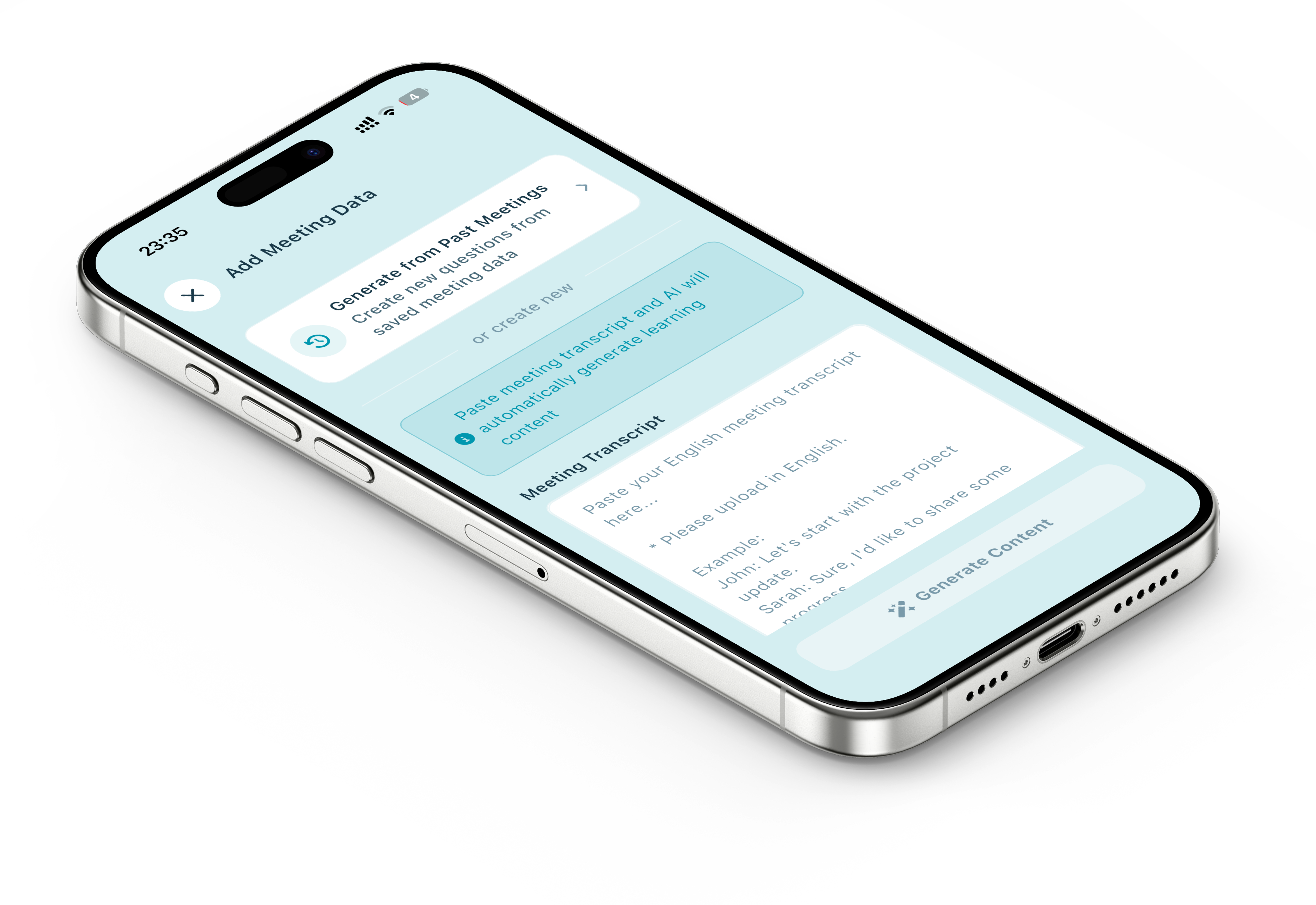
It’s January 30th, and we’re still in that stretch of the year when new goals feel fresh and the calendar is full of meetings. If you’ve been in a few English calls already and thought “I wish I could practice from this,” you’re not alone. So today I’d like to talk about the feature we’re most proud of in FlashPhrase: using AI to turn your own meeting notes and transcripts into highly practical learning content.


Many business-English tools rely on generic scripts and sample dialogues. FlashPhrase takes a different approach. It uses your real meetings—the transcripts and notes you already have—and turns them into targeted phrase practice and “problems” you can actually use in your next call or meeting. Below we explain how that works and why it makes your practice super practical.


Learning from your own context

The core idea is simple: the best practice comes from the situations you’re already in. When you paste a meeting transcript or upload notes from a call you had, FlashPhrase doesn’t just show you random phrases. It analyzes what was actually said in that meeting, and what you might want to say better next time.

Because the content is built from your meetings, the phrases and “problems” the AI generates are directly relevant to your job, your team, and your industry. You’re not studying abstract textbook English; you’re studying the kind of English that would have helped in that meeting and will help in the next one.


From raw notes to ready-to-use practice

Once you add a meeting (title, type, and transcript or notes), FlashPhrase’s AI (powered by Gemini) gets to work. It extracts useful phrases and expressions from the transcript, improves them into clearer, more natural English where needed, and categorizes them—for example opening, stating opinion, confirming, disagreeing, or deferring—so you see when to use each one. It also adds context and usage tips so you know how to use them in real situations.

The result isn’t a list of unrelated sentences. It’s a set of practice items tied to a real meeting. Each phrase becomes a “problem” you can drill: read it, say it, get grammar feedback, and add it to your phrase book. That’s what we mean by “super practical”: the problems are generated from your own work context and designed for reuse in similar situations.


Why “from your notes” matters

With generic materials, you often think “I’d never say that in my meetings.” With FlashPhrase, the starting point is your meeting. The AI doesn’t invent a fictional scenario; it uses the vocabulary, topics, and flow of a conversation you were part of. So the “problems” and phrases feel immediately applicable—because they’re derived from situations you’ve already been in and will be in again.

That’s why we call this the app’s biggest feature. It closes the gap between “study” and “use.” You’re not just learning business English; you’re learning the English of your own meetings, turned into structured, repeatable practice.


The flow in a nutshell

You create or paste meeting notes (for example from Google Meet, Teams, Plaud, or manual notes). You enter a title and meeting type so the AI can tailor its analysis. The AI then extracts and refines phrases, adds categories and usage tips, and turns them into learning content. You practice with phrase cards, voice input, and grammar check—all based on that single meeting. Learned phrases and words are saved in your phrase book and vocabulary for review anytime. So the loop is: your meeting becomes your notes, then AI-generated practice, then you reuse what you learned in your next meeting.

To wrap up: FlashPhrase’s biggest feature is using AI to create highly practical English practice from the meeting notes and transcripts you create. By turning your real meetings into phrase extraction, improvement, and drill-style “problems,” the app helps you study the English you actually need—in context and ready to use.

In future posts we’ll go deeper into other features and study tips. If you haven’t yet, try adding one real meeting (or a sample transcript) and see how the AI builds your practice from it.


FlashPhrase is available on the App Store.

Buying time when you need to think

January 30, 2026

Imagine you're in a crucial meeting. A challenging question comes your way, and you're put on the spot. You need a moment to gather your thoughts, recall data, or simply formulate a diplomatic answer. What do you say? This is where the skill of "buying time" comes in handy. It's a professional strategy that allows you a brief pause without appearing unprepared or hesitant. It gives you the precious seconds you need to formulate a clear, confident, and accurate response. One of the most effective and polite phrases for this purpose is "Let me think about that for a second." This expression isn't about avoiding the question; it's about signaling that you are taking the inquiry seriously and want to provide the best possible answer, not just a quick one. When should you use "Let me think about that for a second"? Consider it when faced with complex questions, needing to recall specific figures or details, or when you want to craft a diplomatic response to a sensitive issue. It's also perfect if you're momentarily caught off guard and need to process unexpected information. By using this phrase, you communicate professionalism and thoughtfulness. You avoid awkward silences or worse, giving a rushed and potentially incorrect answer. It shows that you value accuracy and careful consideration over speed. Here’s an example: Your manager asks: "What are the potential budget implications if we expand into the Southeast Asia market next quarter?" Instead of guessing, you can confidently respond: "That’s a critical question. Let me think about that for a second. Based on preliminary research, we would need to allocate resources for..." Adding "Let me think about that for a second" to your business English toolkit will empower you to handle challenging questions with grace and professionalism. It’s a small phrase that buys you valuable time and demonstrates your ability to think strategically under pressure.

Takeaway phrases

  • Let me think about that for a second.

Asking for clarification without sounding unprepared

January 29, 2026

In the fast-paced world of global IT company meetings, speed and shared assumptions are critical. Decisions are made quickly, and often, discussions proceed with a sense of partial ambiguity rather than a complete lack of understanding from everyone involved. You might feel like you get the general gist, but some specific details or implications remain fuzzy. Allowing this ambiguity to persist is a common trap. It often leads to significant rework, missed deadlines, or a critical misalignment in understanding later down the line. That's why asking for clarification is not just good practice, it's essential for project success. Here's an important cultural difference: in English-speaking business environments, asking for clarification itself is generally not seen as a negative thing. It shows engagement and a commitment to accuracy. The key, however, lies in how you ask. There's a big difference between an asking style that emphasizes your personal lack of understanding versus one that frames it as a check for overall team alignment. Phrases like "I don't understand" can sometimes make you sound unprepared or not fully engaged. In business English, expressions centered around "alignment" and confirming shared understanding are far more effective and professional. This brings us to a powerful, versatile phrase: "Just to make sure I understood correctly…" This phrase is excellent because it doesn't imply you completely missed something. Instead, it suggests you have an understanding, but you want to perform a quick check for accuracy and to ensure everyone is on the same page. It pivots the focus from your potential misunderstanding to a collective desire for clarity and alignment. When to use it: ・When you've heard a lot of information and want to summarize a key point to confirm. ・When a specific instruction or next step seems a little vague. ・When you want to confirm implications or dependencies. Example: "We're launching the new feature next Monday. Just to make sure I understood correctly, the marketing assets need to be finalized by end of day today, right?" Having one go-to, repeatable phrase like this is far more practical and effective in a real business setting than trying to craft complex sentences on the fly. It allows you to quickly and confidently seek clarification, ensuring that everyone's understanding is truly aligned without putting you on the spot. By adopting this approach, you'll not only prevent costly misunderstandings and rework but also enhance your professional image as a thorough and engaged team member.

Takeaway phrases

  • Just to make sure I understood correctly…

Interrupting Politely in English

January 28, 2026

In global IT organizations, meetings are conducted at speed. Participants are expected to follow discussions in real time, respond quickly, and make decisions collaboratively across cultures and time zones. In such environments, business English is not evaluated by grammatical accuracy alone, but by how effectively it supports participation. One situation that frequently challenges non-native speakers is interruption. Meetings often progress before every detail has been fully absorbed. A key assumption may be unclear, or an important point may pass too quickly. In these moments, continuing without clarification can lead to misalignment later. From a business perspective, it is usually better to pause briefly than to proceed with uncertainty. However, many English learners hesitate to interrupt. This hesitation does not stem from a lack of vocabulary, but from uncertainty about how interruption is perceived in English-speaking business contexts. In international meetings, interruption itself is not considered inappropriate. What matters is how it is framed. Native speakers typically signal respect for the speaker and awareness of the meeting flow before entering the conversation. This short verbal buffer allows the interruption to be received as constructive rather than disruptive. Understanding this pattern is an important learning point for business English. Rather than searching for complex expressions, learners benefit more from acquiring a small number of reliable phrases that allow them to participate naturally when timing matters. One such phrase is: “Sorry, can I jump in for a second?” This expression is widely used in professional settings because it balances politeness and efficiency. It signals a brief intervention, creates space to speak, and allows the speaker to follow with clarification, confirmation, or redirection as needed. Its versatility makes it effective across internal discussions, client meetings, and cross-functional reviews. Business English is most effectively developed by focusing on recurring situations rather than abstract language knowledge. Meetings, in particular, reward readiness over range. Having one phrase that can be used confidently at the right moment often contributes more to productive participation than knowing many expressions that remain unused. By approaching English learning through real meeting scenarios and mastering one practical expression at a time, learners can gradually reduce hesitation and engage more actively in global discussions.

Takeaway phrases

  • Sorry can I jump in for a second?